
High-Converting Landing Pages for Pennsylvania Contractor Services
A homeowner in Lancaster found your ad for roof replacement services. She clicked. She arrived on your homepage. There was a menu with seven options, a rotating photo carousel, a paragraph about your company history, and a contact form buried at the bottom. She looked for a moment, could not find what she needed quickly, and left.
The ad worked. The landing page did not.
Landing pages for Pennsylvania contractor services solve a specific problem. A person searching for a specific service in a specific location arrives somewhere that speaks directly to that search, answers their question immediately, and makes the next step obvious. A homepage cannot do that for every service and every city in your area. A dedicated landing page can.
Contractor website design in Pennsylvania that generates consistent leads is built around this structure. The homepage handles your overall brand and service area. The landing pages handle every specific combination of service and location that matters to your business.
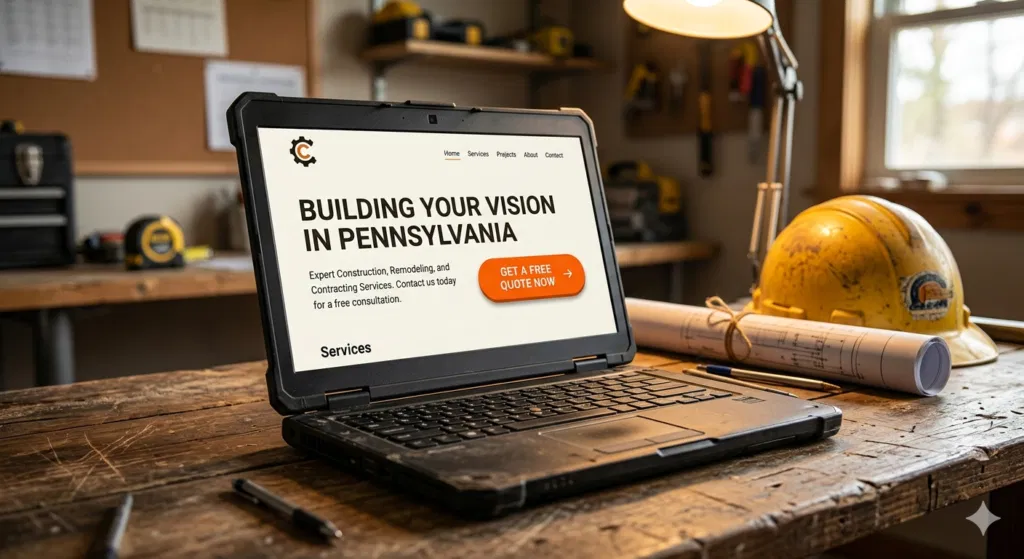
What Makes a Landing Page Different From a Service Page?
A service page covers everything about a particular type of work you do. It is thorough and informative. A landing page focuses on a single action you want the visitor to take. It removes everything that does not support that action and guides the person toward one outcome: contacting you.
For a contractor covering the Philadelphia metro, a page targeting “roof replacement Bucks County” is not the same page as one targeting “emergency roof repair Philadelphia.” The visitor intent is different. The urgency is different. The questions they are asking are different. Each needs its own page, its own content, and a call to action matched to that specific need and that specific moment.
The Structure of a Landing Page That Converts
The first thing a visitor sees when they arrive on a landing page should answer the question that brought them there. Not your company history. Not a list of everything you offer. The answer to the specific problem they came to solve.
A homeowner looking for an emergency plumber in Harrisburg does not need to know about your 20 years in business before they see a phone number. They need the number first, confirmation that you serve Harrisburg, and evidence that you can handle the situation. Everything else follows that sequence. Answer first, credibility second, process third, next step present throughout. That structure is what makes a landing page perform where a general page does not.
Location Specificity Is Not Optional in Pennsylvania
Pennsylvania is not a single market. A contractor serving the Lehigh Valley and a contractor serving the Pittsburgh metro are operating in two different competitive environments, even if they offer identical services. A landing page targeting “HVAC installation Allentown” needs to name Allentown. It needs to reference the surrounding area. It needs to feel as though it was written for that specific community rather than adapted from a template that could describe any contractor anywhere.
This matters to visitors because it signals that you actually work there. It matters to Google for exactly the same reason. A page that names specific cities and counties in your service area and references local context ranks more reliably for local searches than a generic page. Local SEO for Pennsylvania contractors covers how to build the full location and service structure. Landing pages are where that strategy becomes tangible and measurable.
The Elements That Separate Converting Pages From Traffic Pages
A landing page can rank well and receive consistent traffic without generating a single contact. Traffic is not conversion. What moves a visitor from reading to reaching out is a specific set of elements placed in the right order.
A clear headline that names the service and location. A short, direct explanation of what you do and how the process works. Evidence that you have completed this work nearby, shown through photos and specific project descriptions. Social proof from real clients in the area. A contact form or phone number that is impossible to miss. And one clear call to action that tells the visitor exactly what to do next.
Integrating reviews and testimonials into your Pennsylvania contractor website covers the social proof component in full. On a landing page, a single strong testimonial from a client in the target city placed next to the contact form does more conversion work than a full page of company description.
How Many Landing Pages Does a Pennsylvania Contractor Need?
The answer depends on how many distinct services you offer and how many distinct markets you serve. A roofing contractor covering five counties in Central PA who does both residential replacement and commercial flat roofing could build separate landing pages for each service in each county. That is ten pages with specific, location-targeted content, each one intercepting a different search from a different type of buyer.
You do not need to build all of them at once. Start with your highest-value service in your most competitive market. Build that page correctly, measure how it performs, and expand from there. A single well-built landing page for “kitchen remodeling Pittsburgh suburbs” that generates consistent contacts is worth more than a dozen generic service pages.
What to Avoid on a Contractor Landing Page
The most common problem with contractor landing pages is trying to cover too much. A page targeting siding replacement in Delaware County that also mentions roofing, gutters, windows, and a financing program is no longer a landing page. It is a homepage in disguise. It does not focus the visitor and it does not tell Google what the page is specifically about.
Keep each landing page to one service, one location, one goal. Everything on the page should support the decision to contact you about that specific service in that specific place. If another service is worth mentioning, link to its own page rather than absorbing it into this one. Clear structure produces clearer results.
The Long-Term Value of Building This Structure
A library of well-built landing pages is a compounding asset. Each page targets a specific search. Each page that ranks brings in visitors who are already looking for exactly what you offer in exactly the area you serve. Over time, a contractor with 15 or 20 location-specific service pages has a fundamentally different lead pipeline than a contractor with a five-page brochure site, even if the brochure site looks more expensive.
Intekk Media’s approach to contractor website design in Pennsylvania is built around this kind of long-term structure. The goal is not a beautiful homepage. The goal is a site that consistently intercepts the right searches and converts them into real contacts. If you want to understand what that would look like for your trade and service area, the first step is a straightforward conversation about where the current gaps are.